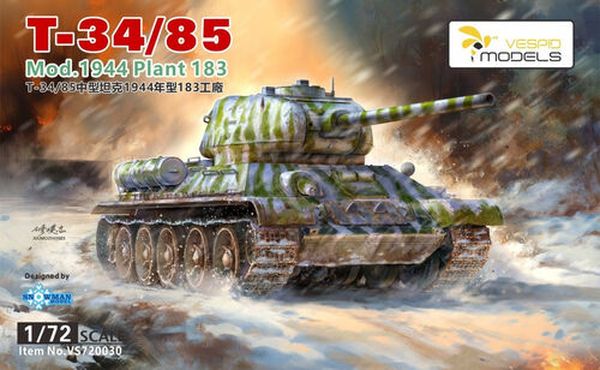
T34/85 Mod.1944 Plant 183 Medium Tank 1/72 - VESPID MODELS VS720030
$ 37.06
T34/85 Mod.1944 Plant 183 Medium Tank 1/72 - VESPID MODELS VS720030
T34/85 Medium Tank Kit Mod.1944 Establishment 183 in 1/72 scale - Vespid Models. The T-34 was a Soviet medium tank of World War II and the postwar period. The first prototypes were built in 1937-1940, and mass production in the USSR took place in 1940-1957. Over its course some 84,000 such vehicles were built, making the T-34 one of the most produced tanks in history! Transmission was provided by a single V-2-34 engine with a power output of 500 hp. The length of the car - in the T34/76 version - was 6.68 m, with a width of 3 m. The armament consisted of a 76.2 mm F-34 cannon and two 7.62 mm DT machine guns. The main armament in the T-34/85 version was the 85 mm ZIS-S-53 cannon. The T-34 is undoubtedly one of the most famous tanks in World War II history and military history in general, representing a specific symbol of Soviet victory in the war with the Third Reich. The vehicle was developed for the needs of the Red Army as a successor to the so-called BT series pursuit tanks (BT-5 and BT-7), but also the T-26 tank. Work on the car began in 1937 in a special design office at the Steam Engine Factory in Kharkiv. Initially, work was directed by Engineer Adolf Dik (he also made the first sketches of the new car), and after his arrest by Soviet security authorities, Mikhail Koszkin managed the work. Initially, the vehicle was designated as the A-20. However, a second prototype (A-32) was quickly built, with main armament in the form of a 76.2-mm cannon and much thicker front armor. It was the latter prototype that was finally adopted for production. It can be assumed that when it was introduced into service, the TT-34 was a highly successful tank in many respects. It featured-as in 1940-a very powerful weapon, had a well-profiled armor based on sloping armor plates, as well as very high mobility and off-road driving properties. Disadvantages included poor car ergonomics and not the best optics used in early production batches. Despite these shortcomings, when the T-34 appeared on the Eastern Front, German troops were very surprised. The T-34's high overall rating and combat values led to its mass production and made it the Red Army's base tank during the 1942-1945 fighting. They also led to further design improvements, for example, a new hexagonal tower appeared in 1942, improving the quality of crew members' work with the commander's dome. The engine and gearbox were also improved. In 1944 the T-34/85 model was introduced into service, with a completely new three-man turret and main armament in the form of an 85 mm cannon. The T-34 tank fought in virtually every major battle fought between the Red Army and the Wehrmacht on the Eastern Front in 1941-1945: starting with the Battle of Moscow, through the battles of Stalingrad and Kursk, Operation Bagration, and the capture of Berlin. After 1945, the T-34 tank was still in service, it was also widely exported outside the USSR to countries such as Czechoslovakia, Poland, East Germany, Hungary and Syria.